
 ChatGPT
 Claude
 Perplexity
 Gemini
 Grok
GrokConversion benchmarks by institution type
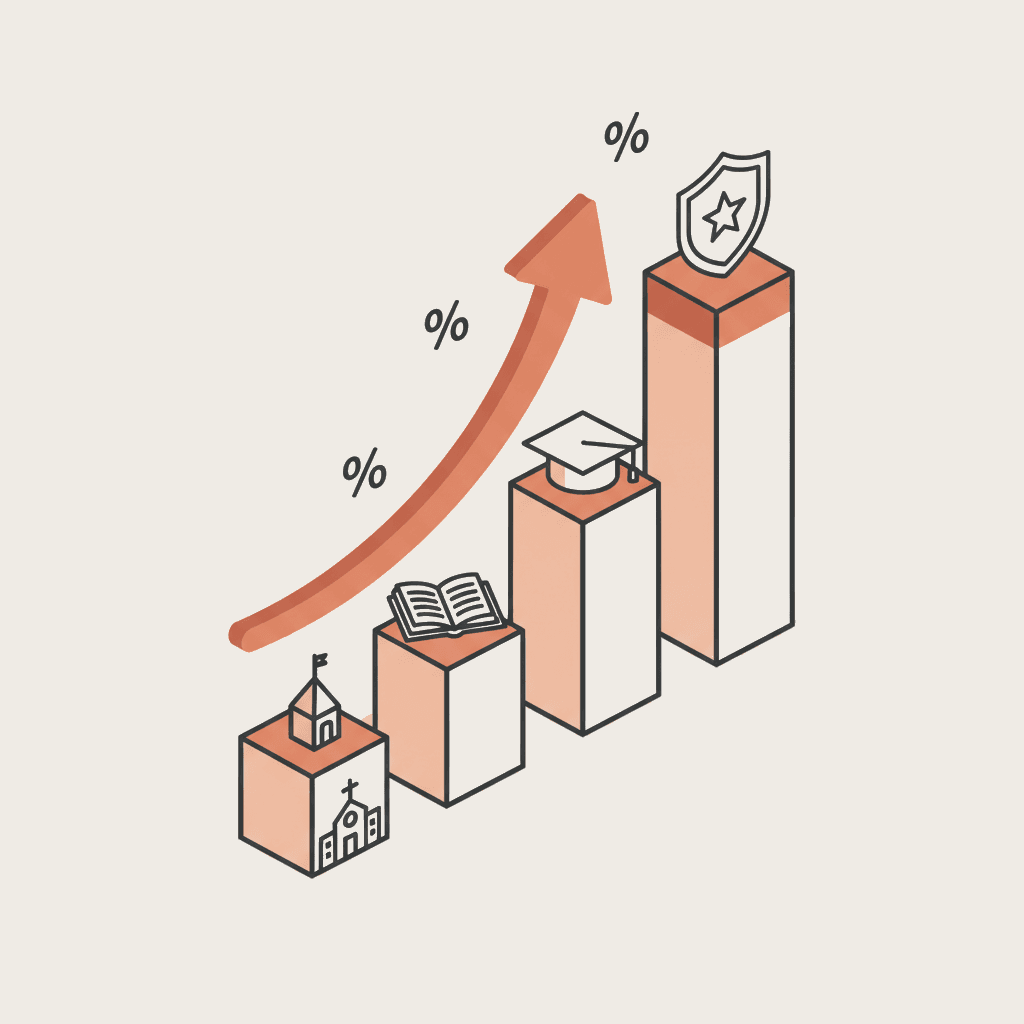
The conversion rate of a higher education website -- the percentage of visitors who ultimately enrol -- varies dramatically by institution type. IT and computing schools lead at 5.2 %, followed by engineering schools at 4.1 %, private universities at 3.0 %, business schools at 2.3 %, and communications schools at 1.8 % (Source: Skolbot analysis of conversion data from 50 partner institutions, 2025-2026 academic year).
These gaps are not random. They reflect structural differences in decision pathways, applicant profiles, and the nature of the academic offering. Understanding where your institution sits against these benchmarks is the starting point for any optimisation strategy.
For the wider context of student recruitment challenges, see our guide on how to recruit more students in private higher education.
Why conversion rates differ so much by institution type
IT and computing schools: a seller's market
The 5.2 % conversion rate for computing programmes reflects a supply-demand imbalance that favours the institution. The well-documented shortage of software developers and data engineers -- reported by employers across Europe and tracked by Eurostat -- means candidates enrol quickly. Their decision path is short: they know they will find employment; the question is simply where to train.
Engineering schools: a structured decision path
At 4.1 %, engineering programmes benefit from clear ranking systems and competitive entry processes. In the UK, The Complete University Guide and The Guardian University Guide narrow options effectively. Candidates compare a limited set of Russell Group and top-ranked institutions, which shortens the decision cycle.
Business schools: a crowded market
The 2.3 % rate for business schools reflects market saturation. Europe alone has hundreds of accredited business schools, many competing for the same profiles with similar value propositions. Candidates navigate between near-identical claims, which extends the journey and increases drop-off.
Communications schools: a positioning challenge
At 1.8 %, communications and media schools face a readability problem. Candidates struggle to differentiate programmes and to project themselves into concrete career outcomes. The decision path is long and marked by hesitation.
How to measure your conversion rate properly
Before optimising, you need to measure. And measuring correctly is less straightforward than it sounds.
Define your funnel stages
An overall conversion rate hides friction points. Break the journey into measurable stages. The first is visitor to first contact (form submission, chat interaction, phone call). The second is first contact to submitted application. The third is application to confirmed enrolment.
Prospects visit an average of 4.7 pages before asking their first question, but this varies by institution type: 5.2 pages for business schools, 3.9 for engineering schools, and 3.1 for computing schools (Source: analytics and session replay, 15,000 prospect journeys, 2025-2026).
This figure reveals the effort a prospect invests before deciding to interact. The more pages they need to visit, the higher the abandonment risk.
The pages that matter most before first contact
Certain pages play a decisive role. The programme or course page appears in 92 % of prospect journeys before first contact. The fees and funding page in 78 %. The admissions page in 71 %. The student life page in 54 %. These four pages concentrate the bulk of the decision.
If any of them is poorly designed, unclear, or incomplete, the conversion rate suffers directly.
Essential measurement tools
Google Analytics 4 with correctly configured conversion events is the baseline. A session replay tool such as Hotjar or Microsoft Clarity allows you to watch real prospect journeys. A CRM with multi-touch attribution identifies each channel's contribution to the final conversion.
What drives conversions: the key factors
Response time
The factor most strongly correlated with conversion is first-contact response speed. We analyse this in detail in our article on why response time kills enrolments. The summary: under 5 minutes, conversion rates surge. Beyond 24 hours, they collapse.
The impact of chat on bounce rates
Bounce rates drop from 68 % without chat to 41 % with an AI chatbot -- a 39.7 % relative reduction (Source: A/B testing across 22 partner institution websites, Sept -- Dec 2025). Chat does not just retain visitors: it nearly doubles page views per session (from 1.8 to 3.4) and triples session duration (from 1 min 45 s to 4 min 12 s).
A visitor who stays longer, views more pages, and interacts with a chatbot has a substantially higher conversion probability. The mechanism is straightforward: the more a prospect invests in discovery, the higher the psychological cost of abandoning the process.
Clarity of the offering
The highest-converting websites share a common trait: clarity. Tuition fees are displayed openly (not "available on request"). Entry requirements are explicit. Career outcomes are quantified (employment rate at 6 months, median salary). Alumni testimonials are specific, not generic.
Every hidden or ambiguous piece of information is a conversion brake.
Mobile optimisation
In 2026, 74 % of traffic to higher education websites comes from smartphones, according to SimilarWeb data. A site that does not work seamlessly on mobile -- long forms, small buttons, slow loading -- loses three quarters of its audience before the first click.
A five-step action plan
Step 1: Audit your current funnel. Configure Google Analytics 4 with conversion events at each stage (visit, chat/form interaction, application, enrolment). Identify your stage-by-stage conversion rate and compare it to the benchmarks for your category.
Step 2: Analyse real journeys. Install a session replay tool and observe 50 complete prospect journeys. Note exit pages, hesitations, and back-and-forth navigation. These behaviours signal friction points.
Step 3: Fix your critical pages. Prioritise the four most-visited pages before first contact (programme, fees, admissions, student life). For each, verify that key information is visible within 10 seconds.
Step 4: Deploy a chatbot. An AI chatbot reduces bounce rates, extends sessions, and qualifies prospects around the clock. The conversion impact is measurable within the first weeks.
Step 5: Measure and iterate. Run A/B tests on the most-visited pages. Test one change at a time (headline, CTA, form placement). Validate every modification with data, not assumptions.
For more on the questions your prospects are actually asking, see our article on the 15 most common questions before enrolment.
FAQ
What is a good conversion rate for an education website?
It depends on the institution type. For a computing school, above 5 % is strong. For a business school, exceeding 2.5 % is already ambitious. The cross-category average is approximately 3 %, but this figure masks very different realities.
Why do business schools convert at lower rates?
Three factors compound: market saturation (hundreds of accredited business schools across Europe), similar value propositions between institutions, and high tuition fees that extend the decision cycle. Prospects compare more options and hesitate longer.
How do I know if my bounce rate is too high?
A bounce rate above 60 % on an education website warrants attention. Above 70 %, it is a warning sign. Adding interactive chat can reduce this by nearly 40 %. But bounce rate alone is insufficient: cross-reference it with session duration and pages per session for a complete picture.
How long does it take to improve conversion rates?
Quick fixes (adding a chatbot, displaying fees, simplifying the contact form) produce results in 2-4 weeks. Structural optimisations (page redesigns, nurture sequence implementation) take 2-3 months to show their full effect.
Should we display tuition fees on the website?
Yes. Hiding fees creates distrust and filters candidates at the wrong stage of the journey. Institutions that display fees openly have a first-contact rate 25-35 % higher than those requiring prospects to "contact admissions" for pricing.
Want to compare your conversion rate against the benchmarks for your category? Request a free prospect journey audit.
Book a free demo