
 ChatGPT
 Claude
 Perplexity
 Gemini
 Grok
GrokThe wrong CRM costs you more than its licence fee
Most UK universities and colleges have a CRM. Far fewer use it well. When I audited digital recruitment processes across 12 institutions over the past three years, the pattern was consistent: CRM data was incomplete, automation was underused, and admissions staff had reverted to spreadsheets for anything time-sensitive. The problem wasn't the teams — it was tools chosen for generic sales cycles, not for the complexity of higher education recruitment.
The stakes are real. A postgraduate applicant researching programmes compares three or four institutions simultaneously. The one that responds fastest with relevant information wins the interview request. In clearing, a 15-minute advantage can determine whether a student accepts your offer or a competitor's.
This guide compares the leading platforms for UK and international institutions in 2026, with specific attention to UCAS integration, AI capabilities, and what the data says about ROI.
The leading CRM platforms for UK higher education
| Platform | Best for | UCAS integration | AI capabilities | Indicative cost | |---|---|---|---|---| | Slate (Technolutions) | Admissions-heavy institutions | Native | Limited built-in | Custom pricing | | Salesforce Education Cloud | Large universities, multi-campus | Via connector | Einstein AI | From £150/user/month | | Element451 | Digital-first recruitment | API | Conversational AI, SMS | £30K–80K/year | | HubSpot | Inbound marketing focus | API | Marketing AI | £45–800/month | | Ellucian CRM Recruit | Existing Ellucian SIS users | Native | Dynamics 365 AI | Custom pricing |
Slate: the benchmark for UK admissions teams
In a 2025 survey of UK higher education professionals, Slate was cited as the most widely used admissions CRM (55%), a position it has held since 2022. Its strength is configurability — Slate Designer allows institutions to build custom applications, workflows, and communications without writing code. For institutions processing tens of thousands of UCAS applications annually, the native integration and track-record justify the investment.
Where Slate falls short is marketing automation at scale. It was built for admissions, not for the full recruitment funnel from awareness to enrolment. Many institutions pair it with a separate marketing automation tool — which adds complexity.
Element451: built for Gen Z engagement
Element451 has grown rapidly in UK institutions looking to modernise their prospect engagement. It offers conversational AI for 24/7 enquiry handling, SMS-first communication (critical for clearing), and mobile-optimised portals that match how prospective students actually browse. The platform's AI lead scoring surfaces high-intent prospects automatically — useful when managing thousands of applications across multiple cycles.
Its limitation is integration depth with legacy student information systems. If your institution runs Banner or Colleague without an IT team available for API work, implementation can be prolonged.
HubSpot: the marketing-first option
HubSpot is not purpose-built for higher education, but its marketing automation capabilities are unmatched. Institutions with strong inbound marketing strategies — content, SEO, paid social — find HubSpot more intuitive than specialist education platforms. The free CRM tier gives smaller institutions a starting point before committing to paid tiers.
For UK-specific context, HubSpot has ICO-compliant data processing agreements in place and data centres within the EEA. Its API is fully open, which matters if you want to connect an AI chatbot for out-of-hours prospect engagement.
Selection criteria UK institutions cannot afford to ignore
1. UK GDPR and ICO compliance
The UK GDPR applies to all UK institutions regardless of where their CRM vendor is headquartered. Your contract must include a Data Processing Agreement, and you must be able to demonstrate lawful basis for each category of personal data processed. The ICO's updated guidance on AI in education (published 2025) adds requirements around automated decision-making in admissions — verify your CRM vendor's compliance position before signing.
US-based platforms (Salesforce, HubSpot, Element451) process data outside the UK unless specifically configured otherwise. This is permitted under an adequacy-equivalent basis but requires explicit DPA provisions.
2. UCAS integration and clearing readiness
Clearing is a short, intense window where data velocity determines results. During the 2025 clearing cycle, institutions using real-time CRM-UCAS sync reported a 23% faster response to clearing enquiries than those with manual processes, according to UCAS institutional data. JISC's digital infrastructure guidance also flags CRM-SIS interoperability as a top technology priority for UK higher education in 2026. Verify whether your CRM vendor offers native UCAS export/import or whether you'll need a custom API build.
3. Open API for AI integration
This is the non-negotiable criterion for 2026. A CRM without an open API locks you into a closed ecosystem. When your institution is ready to connect an AI chatbot for 24/7 prospect engagement — and most institutions are asking this question now — a closed CRM means starting over.
4. QAA and TEF data requirements
The TEF framework rewards institutions that demonstrate strong student outcomes and engagement. Your CRM should be able to generate reports that map to TEF evidence categories: progression data, student engagement records, and satisfaction indicators. Check whether your shortlisted platforms have pre-built TEF reporting modules or whether this requires custom development.
What the data shows about CRM and AI integration
The clearest argument for connecting your CRM to an AI chatbot is the out-of-hours engagement problem. In 2025–26, 67% of prospect activity happened outside office hours, with the absolute peak on Sunday evenings (Source: Skolbot interaction logs, 200,000 sessions, Oct 2025 – Feb 2026). No admissions team covers this window.
When institutions connected an AI chatbot to their CRM, the results were consistent: qualified leads increased by 62% (from 120 to 195 per month), cost per qualified lead fell by 38% (from £42 to £26), and 12-month ROI reached 280%. (Source: median results across 18 institutions, including concurrent funnel optimisations, 2024–2025.)
The mechanism matters. The chatbot qualifies the enquiry (intended programme, level, full-time or part-time), pushes the structured data into the CRM contact record, and triggers the appropriate nurturing sequence — all without admissions staff involvement. The team reviews qualified, scored prospects in the morning rather than raw enquiries.
For more on how to structure these sequences, see our guide to email nurturing for student prospects.
The integration architecture that works
The most effective setup we see across UK institutions in 2026 follows a clear pattern:
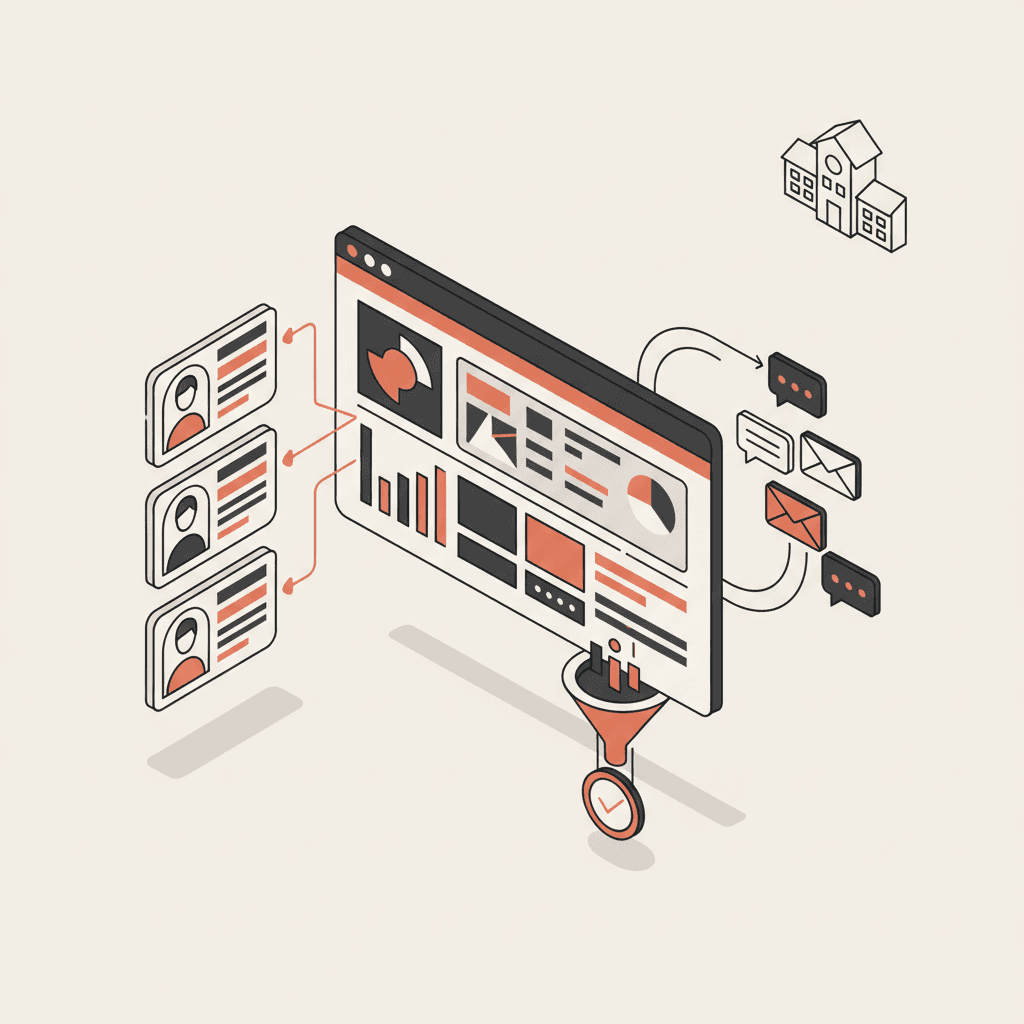
Website traffic → AI chatbot (qualification + 24/7 engagement) → CRM (scored contact + triggered sequence) → Admissions team (qualified prospects only)
The chatbot handles the top of the funnel: FAQ responses, programme navigation, open day registration. Everything structured and qualifying flows into the CRM automatically. Your admissions advisers focus on the conversations that require human judgement.
This is not a replacement for human contact — it is a filter that ensures every human conversation is worth having. For institutions managing clearing, this architecture becomes essential: the chatbot handles volume while advisers focus on conversion.
For a detailed look at how AI chatbots automate open day registration, see how an AI chatbot automatically registers prospects for open days.
Common implementation mistakes
Buying on features, deploying without a process map
The most common failure mode is purchasing a sophisticated CRM, then trying to map existing chaotic processes onto it. A CRM does not fix unclear ownership of leads, competing priorities between marketing and admissions, or a 48-hour response SLA that nobody enforces. Before procurement, document your current recruitment funnel step by step and identify where candidates drop off.
Ignoring the first-year data hygiene
CRM quality degrades quickly without maintenance. Duplicate records, outdated contact details, and unscored leads accumulate. Build a data hygiene routine into the project plan from day one: deduplication rules, contact validity checks, and a clear data retention policy aligned with UK GDPR.
Under-resourcing the training phase
A CRM that admissions staff don't trust is a CRM that sits unused. Budget for two full days of initial training per user cohort, plus quarterly refreshers. The institutions with the highest CRM adoption rates in the UK are those that designated internal champions — typically senior admissions advisers who tested the system in parallel before rollout.
For an overview of the complete digital marketing ecosystem for higher education, read our digital marketing guide for higher education.
Test Skolbot on your institution in 30 seconds
FAQ
What is the difference between a CRM and a student information system (SIS)?
A CRM manages relationships with prospective students — from first enquiry through enrolment. A SIS (such as Banner or Colleague) manages enrolled students' academic records, module registrations, and results. You need both, and they should be integrated to avoid double data entry. Most CRM vendors offer connectors to the major SIS platforms.
Is Slate still the best option for UK universities in 2026?
Slate remains the most widely deployed admissions CRM in UK higher education, and its configurability is genuinely unmatched. But it was built for admissions teams, not marketing departments. Institutions with strong digital marketing operations are increasingly pairing Slate with a separate marketing automation platform or moving to more integrated solutions like Element451 or Salesforce Education Cloud.
How long does a CRM implementation take for a mid-sized university?
Between four and nine months for a full implementation, including data migration, integration with the SIS and UCAS, staff training, and a parallel running period. Plan your go-live at least six months before your most intensive recruitment period — typically September for clearing or January for postgraduate rounds.
How do I calculate ROI for a CRM investment?
Start with your current cost per enrolled student (advertising, staff time, events, and materials divided by total enrolments). Then estimate the value of each additional enrolment — for a three-year undergraduate programme at £9,250/year, that is £27,750 in tuition revenue. If better CRM processes produce ten additional enrolments per cycle, the revenue impact is clear even before calculating staff efficiency gains.
Can a CRM handle UCAS Clearing without specialist configuration?
Most platforms can be configured for clearing, but the level of effort varies considerably. Platforms with native UCAS API connections (Slate, Ellucian) handle clearing data flows with minimal custom work. Generic CRMs (HubSpot, Pipedrive) require significant configuration. Given that clearing performance is directly tied to response speed, this is a procurement decision worth getting right.